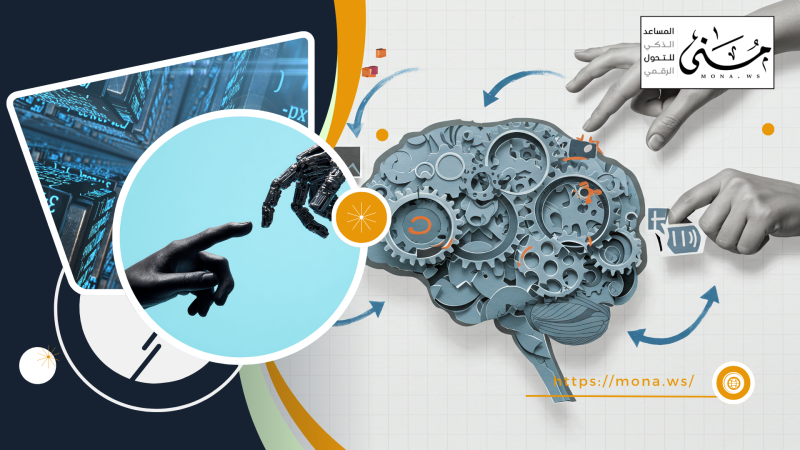
 الذكاء الاصطناعي (Artificial Intelligence): ثورة رقمية تعيد تشكيل حياتنا والمؤسسات
In recent years, Artificial Intelligence (AI) has become one of the most widely discussed terms in the technological, economic, and even social spheres. AI is no longer a science-fiction idea tied to movies or novels; it has turned into a tangible reality that contributes to decision-making, service development, and making human life easier across many fields. At Mona News, we keep pace with fast-moving digital developments and strive to present a simplified analytical view that helps readers understand the technologies shaping the future of business and services. As AI becomes increasingly present in the details of our daily lives, it is essential to get to know this field more closely: What is it? How does it work? And where do we see it today? In this article, we highlight AI as one of the most important drivers of digital transformation globally and in the Arab world, and we review its applications, impacts, opportunities, and upcoming challenges.
What Is Artificial Intelligence?
Artificial Intelligence is a branch of computer science that aims to design systems and software capable of simulating human cognitive abilities such as understanding, learning, reasoning, and decision-making. In other words, it enables machines to “think” in a way that resembles humans—or even surpasses them in certain tasks.
AI relies on several key technologies, most notably:
-
Machine Learning (ML): Systems learn from data and improve over time without being directly programmed for every step.
-
Deep Learning: An advanced form of machine learning based on neural networks that mimics how the brain works.
-
Natural Language Processing (NLP): Enables machines to understand, analyze, and respond to human language.
-
Computer Vision: Allows computers to interpret and understand images and videos.
Why Has Artificial Intelligence Become Important Now?
The main reason behind the major leap in AI is the convergence of three fundamental factors:
-
Big Data: Billions of data points are generated daily from the internet, smartphones, and applications.
-
Computing Power: Advances in processors and graphics units have made data training faster and more accurate.
-
Algorithm Development: Continuous improvement of the mathematical models powering intelligent systems.
These factors have acted as “fuel” for AI, allowing it to penetrate almost every aspect of modern life.
The Most Important AI Applications in Our Daily Lives
We may not always notice it, but AI is around us every day. Here are some of its most prominent applications:
1) In Phones and Applications
• Smart assistants such as Siri and Google Assistant
Smart assistants have become a daily part of phone use. They rely on AI to understand voice commands and execute them quickly. They help users make calls, set reminders, search for information, or control smart home devices. With ongoing development, these assistants are becoming better at understanding the context of conversations and delivering more accurate responses, which enhances user experience and saves time and effort.
• Photo organization and facial recognition
AI is used in photo apps to automatically organize images by classifying them according to location, people, or event type. Through facial recognition technology, phones can identify individuals across multiple photos and group them into dedicated albums, making it easy to find pictures in seconds instead of scrolling manually for long periods.
• Word suggestions while typing and instant translation
When typing on a phone, AI suggests words and sentences based on the user’s style and the context of the text, making writing faster and reducing errors. NLP techniques are also used for real-time translation within apps, enabling texts or conversations to be translated directly with relative accuracy—supporting multilingual communication for travelers, students, and business professionals.
2) In Medicine and Healthcare
• Analyzing medical imaging and early disease detection
AI has improved diagnostic efficiency by analyzing medical images such as X-rays and MRI scans with high accuracy. Algorithms can detect early signs of serious diseases like tumors or heart conditions before they become obvious to doctors, increasing the chances of early treatment and reducing health risks.
• Predicting patient complications by analyzing medical records
By analyzing massive medical records, AI can predict the likelihood of a patient’s condition worsening or future complications occurring. This helps doctors make early preventive decisions—such as adjusting treatment plans or intensifying follow-ups—ultimately improving care outcomes and reducing hospital admissions.
• Accelerating new drug discovery
AI shortens years of pharmaceutical trials by simulating chemical compound effects and predicting results rapidly. It can also suggest promising drug combinations based on genetic and biological data analysis, speeding up the development of new treatments for complex diseases and lowering research costs.
3) In Education
• Smart learning platforms that adapt content to student level
AI-powered educational platforms analyze a student’s performance and interaction with lessons, then provide content suited to their level. If a student struggles with a specific skill, they receive extra explanations and suitable exercises, while advanced students move to more challenging material. This flexibility makes learning more effective and equitable.
• Automated test grading
AI is used to grade tests and assignments quickly and accurately, especially multiple-choice and digital exams. This reduces teachers’ workload and provides instant results for students, along with analytical reports on strengths and weaknesses to help schools improve learning outcomes.
• Virtual tutors for answering questions and support
AI has enabled virtual tutors or educational chatbots that respond to student questions at any time. They can explain concepts, solve examples, and guide students interactively, offering continuous academic support beyond traditional classroom hours.
4) In Commerce and the Economy
• Recommendations in online stores (product suggestions)
E-commerce platforms use AI to analyze a user’s purchases and interests, then recommend products aligned with their preferences and needs. These recommendations increase purchase likelihood and improve the shopping experience by making the user feel that the platform “understands” them and shows what they actually want.
• Analyzing customer behavior and predicting needs
AI studies customer behavior through browsing patterns, interactions, purchase history, and even product reviews. Based on this, companies can predict what a customer may need next, improving marketing, personalizing offers, and boosting loyalty.
• Optimizing supply chains and reducing costs
AI helps companies manage inventory and supply chains intelligently by forecasting demand, selecting optimal transportation routes, and reducing waste. This lowers operational costs, speeds up delivery, and ensures product availability without surplus or shortage.
5) In Security and Cars
• Identifying suspects and analyzing surveillance cameras
Smart surveillance systems can analyze video streams in real time and recognize faces or detect abnormal behaviors. This is used to enhance security in cities, airports, and critical facilities, helping authorities identify suspects quickly and respond more efficiently.
• Self-driving cars
Autonomous vehicles rely on AI to understand roads through cameras and sensors, making driving decisions such as braking, changing lanes, or avoiding collisions. As the technology evolves, it is expected to reduce accidents caused by human error and make transportation safer and more comfortable.
• Smart traffic monitoring and guidance
AI is used in intelligent traffic systems to analyze congestion in real time, adjust signals accordingly, and suggest alternative routes for drivers. This reduces traffic jams, improves city mobility, and lowers travel time and fuel consumption.
Benefits of Artificial Intelligence
There is no doubt that AI delivers major benefits that directly affect individuals and society:
-
Higher productivity: by automating routine tasks.
-
Greater accuracy and fewer errors: especially in industry and healthcare.
-
Saving time and effort: through smart, instant services.
-
Improving government services: such as digital correspondence systems and appointment/service management.
-
Opening new economic opportunities: in programming, data analysis, robotics development, and more.
Artificial Intelligence in the Arab World
In recent years, the Arab world has witnessed rapid momentum toward adopting AI technologies, particularly in Gulf countries that have made AI a core pillar of their development strategies. This trend is evident in accelerating digital transformation in government institutions through service automation and efficiency improvements, alongside investments in building smart cities that rely on data and intelligent systems to enhance quality of life and manage resources. AI also plays a growing role in advancing healthcare and education services through early diagnosis, medical data analysis, and personalized interactive learning. In addition, several Arab countries are supporting innovation and tech entrepreneurship through funding programs and incubators for startups specializing in intelligent solutions. As this landscape expands, investing in technical education and developing local talent becomes increasingly important to ensure an influential Arab presence and effective leadership in the global future of AI.
The Future of Artificial Intelligence: Where Is It Headed?
Experts expect AI to continue expanding in the coming years, with emerging technologies such as:
-
Generative AI: capable of producing new content like text, images, and video.
-
Smart robotics: in homes, hospitals, and factories.
-
Integrated institutional systems: to unify operations, documents, and decision-making.
-
Personalized medicine: through analyzing genes and individual biological data.
While AI is evolving rapidly, the greatest challenge remains ensuring that it is used ethically in ways that serve humanity rather than harm it.
Conclusion
Artificial Intelligence is no longer a luxury or optional technology—it has become a main driver of global progress. It is a powerful tool that can improve our lives and develop economies and services, provided we use it wisely and confront its challenges through education, regulation, and societal awareness. With digital transformation accelerating, understanding AI and acquiring its essential skills is no longer limited to specialists; it is a necessity for anyone who wants to be part of the future.







Comments
Add New Comment